It is a pleasure to announce that my latest article has been published by two major outlets. You can read it on
offiziere.ch
as well as on
bellingcat.com (also in Russian translation).
Apparently, the blogger curdistam also bothered to translate it into Galician-Portuguese.

Posts mit dem Label SAA werden angezeigt. Alle Posts anzeigen
Posts mit dem Label SAA werden angezeigt. Alle Posts anzeigen
12.09.2016

14.09.2015
The rise of the SSNP militia. A sign of strength or hardship?
A distinguishing
mark of modern asymmetric warfare is a wide variety of militias and formations
fighting for one or the other side. Non-professional fighters, loosely
organised into groups and largely uncontrolled by any kind of supreme command, can
inflict horrible damage on an enemy. At the same time, they can easily be
recruited, trained and armed. This also makes them the weapon of choice for
governments both having a weak or overstretched regular army and willing to
fight a war without frontlines, effectively decentralising warfare.
The conflict in
Syria is no exception and has seen dozens of different armed groups fighting
beside the Syrian Arab Army (SAA) on Syrian soil. One of those groups that has
recently gained some momentum and whose men are increasingly pictured battling
their enemies is the militia of the Syrian Social Nationalist Party (SSNP).
 |
| An SSNP technical during the battle of the al-Ghab plains, source |
Men fighting under the party’s Zawba'a-logo have been seen in a fighting role since early 2014. Before that, occasionally photographs were publicised showing supporters of the SSNP, however, they do not bear arms. After all, searching on twitter will reveal pictures of their men, holding weapons, posing as early as during the end phase of the battle of Homs in January/February 2014.
The assembling
and deployment of the SSNP's Nusur az-Zawba’a
(Eagles of the Hurricane) might, at first glimpse, look a little arbitrarily
and even carried out coincidentally, but is just another example of how
sectarian the war in Syria has become. To fully understand that, one must go
into both the SSNP’s political program and the party’s history.
To analyse the
rise of Syrian Social Nationalist Party as a militia, it would be too lengthy
to write a whole history dossier about it. In fact, yet there are several well
written, though sometimes a little aged, reports about the SSNP’s very own
worldview, e.g. here and here. Those reports explain the ideological basis of the
party: a strong believe in the forming of a future so called 'Greater Syria' with
clear references to Assyrian history and the Assyrian kingdom and with an
evenly strong rejection of both Pan-Arabism and Arab nationalism. This led to
a bloody rivalry between the Baath-Party and the SSNP during their early years
and the latter being officially banned in Syria between 1955 and 2005.
 |
| Map of 'Greater Syria', source |
 |
| Map of 'Greater Syria'. Note the references to Assyrian history as well as the Zawba'a-logo, source |
Though the party
claims to be standing for secular politics, its history reveals that it is a
movement which has its roots inside the Christian minority, and to a lesser
extent inside the Druze society, being themselves mostly loyal to the regime
and seeing it as their protector from Islamist forces, however, without being
necessarily Baathist.
The reason that
an SSNP militia was not active before 2014 is the existence of the National
Defence Forces (NDF) which relied heavily on the administrative help of the Syrian Social Nationalists. Back then, SSNP followers fought under the flag of the NDF, though SSNP
insignias, like those of other political or ethnic movements, were sporadically
shown, e.g. on the posters of those who had died in battle.
 |
| Raed Ibrahim Baraka, fallen on October 27th 2013 in Daraa. Note the Zawba'a-logo (top left) and the Druze symbol (top right), source |
One could argue that
the rise of a new militia was a sign of a renewed rise of Bashar al-Assad’s
government, providing a new force to fight against ISIS, Jabhat an-Nusra and
dozens of rebel units. But rather, it is just the other way around.
In the following
months after their first encounters in January 2014 in Homs, Nusur az-Zawba’a were reportedly engaged
in major fighting near Kessab/Latakia (April 2014), Damascus (April/May 2014),
Morek/Hama (November 2014, April 2015), Daraa governorate (February 2015), Tha'lah Military Airbase/as-Suwayda (June 2015) and lately in Zabadani/Rif
Dimashq (since July 2015) as well as in the once again ignited confrontation in
the north western hillside region of Latakia. However, by far the most pictures showing SSNP militiamen at
the scene originate from the battle of az-Zabadani.
 |
| SSNP militiamen at Tha'lah Military Airbase, source |
All of the cities/regions named above hosted a considerable
Christian population before the war (or still host it). Given the fact that there have been strong ties between NDF
and SSNP, the fighters deployed to those battlegrounds are predominantly
locals.
Interestingly,
the regime has split the SSNP fighters from the regular NDF, although the
latter is more or less considered to be a loyal force. Although it is hard to
verify, this could be a sign for that especially Christians since late 2013
have hesitated to join the NDF and other Baath-ideology militias so that the
militia was specifically ‘outsourced’ for them. Even pro-regime news outlets
list them separately from the NDF,
at least since early 2015. This speaks against the theory of the SSNP still being part of NDF and just
being rhetorically separated. As the Christians have mostly been at Assad’s side
and rely on him as their saviour from Islamist revenge, it would be telling
enough to be in the need for a special militia to attract those men to fight.
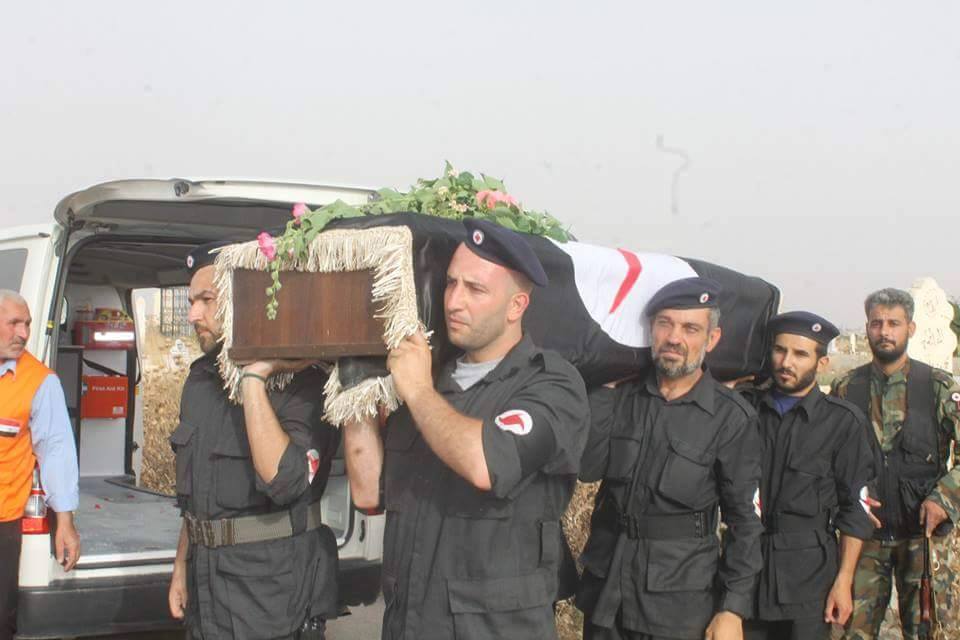 |
| Burial of a fallen SSNP fighter. Especially note that the fallen fighter’s coffin is only draped by an SSNP flag and does not show a Syrian flag at all, source |
This would
basically mean that a self-proclaimed secular power like the Syrian regime has
to rely on politically and religiously defined groups to attract their own
people to join. Of course, the flying personal of the Syrian Arab Air Force
(SyAAF) as well as elite units like the SAA’s 4th Division and Republican Guard
have been dominated by Alawite, Christian and Druze soldiers for decades. But
now they have issues trying to attract men from these loyalist communities.
The battles in
which SSNP has been deployed are in areas largely inhabited by Christians or at
least home to a substantial Christian minority. It is understandable and no
wonder that minority biased units fight the hardest when they act inside
‘their’ cities and face an enemy they see as a threat against their people. For
example, Homs hosted the second largest Syrian Christian population before the
war broke out. Kessab’s population was even up to 80% Christian, the remaining
20% mostly being Alawite. Daraa, az-Zabadani and as-Suwayda are home to a
considerable Christian minority as well, however, Druze being the dominating
ethnic-religious group in the latter governorate. This leads to the conclusion that under
the SSNP logo things did not change much and that the over-all character of the
Nusur az-Zawba’a got closer to
one of a Christian militia, or at
least one of the Syrian minorities.
As for az-Zabadani,
there have been discussions on the social media whether the men of Nusur az-Zawba’a fighting there are
mostly made up of locals like it is presumed for the aforementioned battle
scenes. Though it cannot be verified exactly, it should be very much the case
that the members of the militia are at least from az-Zabadani District, if not
from the town itself. Both, the district and the town, were also the home of a Christian minority which applies to the case of sending fighters to
regions they are emotionally linked to. Moreover, pictures we saw from the
battle of az-Zabadani show SSNP militiamen being in the first line of fire.
This makes definitely sense in a house-to-house combat situation where being in
possession of locals and their knowing of the certain developments and
buildings is crucial.

Conclusion:
So should the
rise of the Nusur az-Zawba’a be seen
as a sign of strength or rather of hardship as I asked in the headline?
Certainly, the
SSNP can be considered a useful militia in certain territories. Its repeated
emergence during major battles in all over Syria and their fight alongside
Hezbollah troops is a sign that they are trusted by the government.
However, we have
also seen that the officially secular regime relies more and more on sectarian
militias or rather those which have a certain religious or political
background. A clear sign for that even the loyalist side is not acting as
united as many might think. Confusingly enough, the SSNP, as mentioned above,
has a long history of animosity against the Baath party. Although politically
the party has took the position of a bloc party and two of its members are ministers in the current cabinet, it is still widely considered as kind of an
opposition party.
Ironically, some
of the major battles in 2014/2015 were fought in fact with the participation of
a militia that was banned for dozens of years under the rule of the very party,
for which it now takes up arms.
19.07.2015
The fight for az-Zabadani - A battle (n)ever seen before
Since the Syrian uprising has escalated into a full-scale war on various fronts inside the country, the mountainous Qalamoun region has gained significant strategic importance. Whoever controls the Syrian-Lebanese border in western Rif Dimashq is capable of influencing the wider Damascus area and its infrastructure. The #1/M2 motorway links the capital with neighbouring Lebanon and Beirut itself. Moreover, the M5 motorway - heading all the way from Jordan in the south to Aleppo in the north and connecting several of Syria’s most important towns and cities - could be blocked (or held open) by those who possess the Qalamoun. One cannot underestimate the significance of these roads to both the rebels and the Baath-regime forces.

The Syrian-Lebanese border has seen various battles over these roads in the last 2.5 years. In 2013, the Syrian Arab Army (SAA), to a heavy extent relying on the help of Hezbollah militiamen, started a large operation to regain full control over the area east of Damascus. SAA and Hezbollah started their attack during mid November, entering the fighting zone from the north and pushing southwards along M5 motorway. The battle of Qalamoun itself lasted for nearly half a year and resulted in a major victory for the forces loyal to Bashar al-Assad. However, what is especially interesting is one certain battle fought during this offensive: the battle for Yabroud.
In fact, the Syrian Arab Air Force (SyAAF) conducted sorties against Yabroud, defended mainly by fighters of Jabhat al-Nusra (JN) as well as Islamic Front and Free Syrian Army (FSA), quite from the beginning of the offensive. SAA and Hezbollah closed in to the town during mid December and were ready to enter it - at least according to their own statements which were repeated several times until the fighting for the town ultimately began. For it was not until March 2014 that fighting started in the outskirts.
Having a quick look at Yabroud reveals the unique position it was built into. The town lies in a ravine and is flanked by hills to the east and to the west. Only five larger streets lead into the city: two from the north and one from each the east, west and south. Being in possession of these roads is the key to the city and makes it quite easy to keep incoming enemies from entering. Nevertheless, a town laying in between heights on both sides faces a permanent threat: being shelled from above.
|

|

It is by no means surprising that the regime‘s forces attack began by starting to secure the hills surrounding Yabroud. Before the urban fighting started, a group of Hezbollah commandos is said to have infiltrated the town and killed 13 rebel commanders. Just one day later, fighters loyal to al-Assad feigned an attack to the west of the town while they actually entered it from the east. Supported by continuous artillery fire, air raids and a lack of cohesion between the defending groups, SAA and Hezbollah managed to conquer and secure Yabroud in not more than five days. As always, propaganda from both sides and the lack of verifiable information makes it nearly impossible to estimate the number of rebels’ and loyalists’ casualties. However, this was a scattering defeat for JN and their allied forces and a decisive victory for the Syrian regime. Hezbollah even published several Nasheeds praising the fighting.
Why it is so important to describe a two year old battle? Because right now there is a battle raging in the Qalamoun region that is astonishingly similar to what is written above: the battle for az-Zabadani.
At the beginning of July 2015, the Syrian regime started the offensive against the last major rebel stronghold left in the Qalamoun region. The town is located in between high grounds to the north-western and south-eastern direction. Outer districts are partly built into steep drops, towering about the city centre. The town is crossed by #113 dual carriage way, besides Barada St going parallel from the south-west, basically the only major street leading into the settlement. This resembles Yabroud.
 |
| az-Zabadani, taken from Google maps |
|

| ||

|


When SAA, National Defense Forces (NDF) and Hezbollah, supported by Iranian officers, started the offensive some two weeks ago, many - most likely also the Syrian officials themselves - suspected this to be a fairly quick to earn victory for Assad’s forces and allies; especially as they had encountered a similar battle before. Like in Yabroud, the defending forces mainly consist of a coalition of JN and Ahrar ash-Sham. After SyAAF helicopters and fighter bombers as well as SAA artillery began to pound the town, Hezbollah infantry went forward coming from western direction. Jamyat neighbourhood, overlooking az-Zabadani, was captured in the first days of the attack. But the offensive stalled only days after it had been initiated. Loyalist forces also tried to break the defenders’ lines in as-Sultani to the south-east of the town.
Since then, a daily ritual can be seen on social networks. Both sides regularly claim territorial gains and say that they could inflict heavy losses on their foe. Interestingly, the footage that emerges on the Internet on a daily basis rarely shows different spots in town which leads to the guess that the battle has basically resulted in a draw.
#Geolocation: #Hezbollah/#SAA captured the high round W of #Zabadani. #Syria #Damascus #Dimashq pic.twitter.com/TAOIV0NtOP
— Shell shocked (@shell_blog) 5. Juli 2015
3/3 Building loc near Ahl al-Bayt mosque. Shot from #Jameeat. #SAA/#Hezbollah hold this pos for days. No progress! pic.twitter.com/Sr7DjFezi3
— Shell shocked (@shell_blog) 13. Juli 2015
The exact reasons for this stalemate are not exactly to be determined, though some major differences to the battle for Yabroud are obvious:
1) In fact, al-Assad’s forces and Hezbollah only control the high grounds to az-Zabadani’s west, but not on the opposite side of the town. Of course, that still enables the regime to overlook az-Zabadani and direct own artillery fire into it. Indeed, you can guess that rebel observers in the eastern parts of the city will do everything to track enemy movements and more importantly look for artillery positions they are being shot at from. It has already been reported (though unconfirmed) that SAA artillery came under fire from inside the town.
2) It is hard to evaluate what the effects of persistent SyAAF attacks and artillery fire are. During the last two years of war, the Air Force has been consistently struggling from a lack of maintenance and suffered losses. A former SyAAF pilot captured by JN stated just days ago that not more than 45 helicopters are in flying condition in all of Syria. Although this very number is hard to verify, it seems likely that the SyAAF is not able to conduct the same amount of sorties as in 2013. Of course, this would have direct influences on the defenders’ condition.
3) Hezbollah forces are now in their fourth year of fighting in this war. Pictures have emerged lately showing militiamen of a very young age. That could be a sign for that Hezbollah generally has lost too many battle hardened fighters during past years and is now forced to fill up its ranks with young, unexperienced fighters.
4) Lastly, the rebel fighters inside az-Zabadani knew about their fate. The city has surely been fortified for weeks if not months before the offensive eventually started. It is to be assumed that tunnels and bunkers were built inside / under the town, booby traps and IEDs were placed and probably precautions were taken to prevent raids like those conducted in Yabroud.
The ongoing battle in az-Zabadani will show whether the Syrian regime is at least capable of keeping the Damascene hinterland free of enemy forces. It would be an important victory in a year that has been nothing but disastrous to al-Assad and his allies.
Abonnieren
Posts (Atom)